

March 2026 Reading on St. Augustine
In February I was looking for an image of St. Augustine and then remembered a talk I went to a dozen years ago where the speaker claimed that he found a signature of St. Augustine. I knew that it was in Russia. After some digging around, I found the article based on the talk by Fr. Kenneth B. Steinhauser: “From Russia with Love: Deciphering Augustine’s Code,” (in The Journal of Early Christian Studies, 22:1, 1-20, 2014). In it he analyzes St. Petersburg, National Library of Russia, Q.v.I.3. This is the oldest extant manuscript containing the works of St. Augustine.
Most of our earliest Latin and Greek manuscripts come from the early 9th century- during the Carolingian Renaissance in modern day France and the revival of the Studite Monastery in Constantinople. So, we have copies of copies of copies… of ancient manuscripts. I have shown some critical editions of Latin and Greek texts in our Latin classes. These are attempts by modern scholars to use all of the surviving manuscripts to get at the originals of ancient texts. It is quite a lot of work!
This manuscript now in Russia was written in the late fourth or early fifth century North Africa (we can tell by the handwriting and abbreviations). St. Augustine would not take pen to hand and write out his works, rather he would dictate his works to scribes. Usually, he wouldn’t write on the book at all. Our manuscript is in the form of a book that we know today rather than an ancient scroll. (Did you know that Christians invented the book form of the codex in the third century? Much more convenient than a scroll for looking for passages in the Bible). From North Africa St. Augustine sent the manuscript to his mentor Simplician, Bishop of Milan. From there it went to the Abbey of Corbie in northern France and eventually found its way to Russia. In fact, Fr. Steinhauser argues that we can date the codex to 397, in Hippo, North Africa, where Augustine was bishop.
Below is a black and white photo of the recto (front) of folio 152. You can find there the following words in a small script not as neat as the rest of the codex. They are to be found in the right-hand column, underneath the border. Note that the “Agustinus” is almost entirely smudged out.
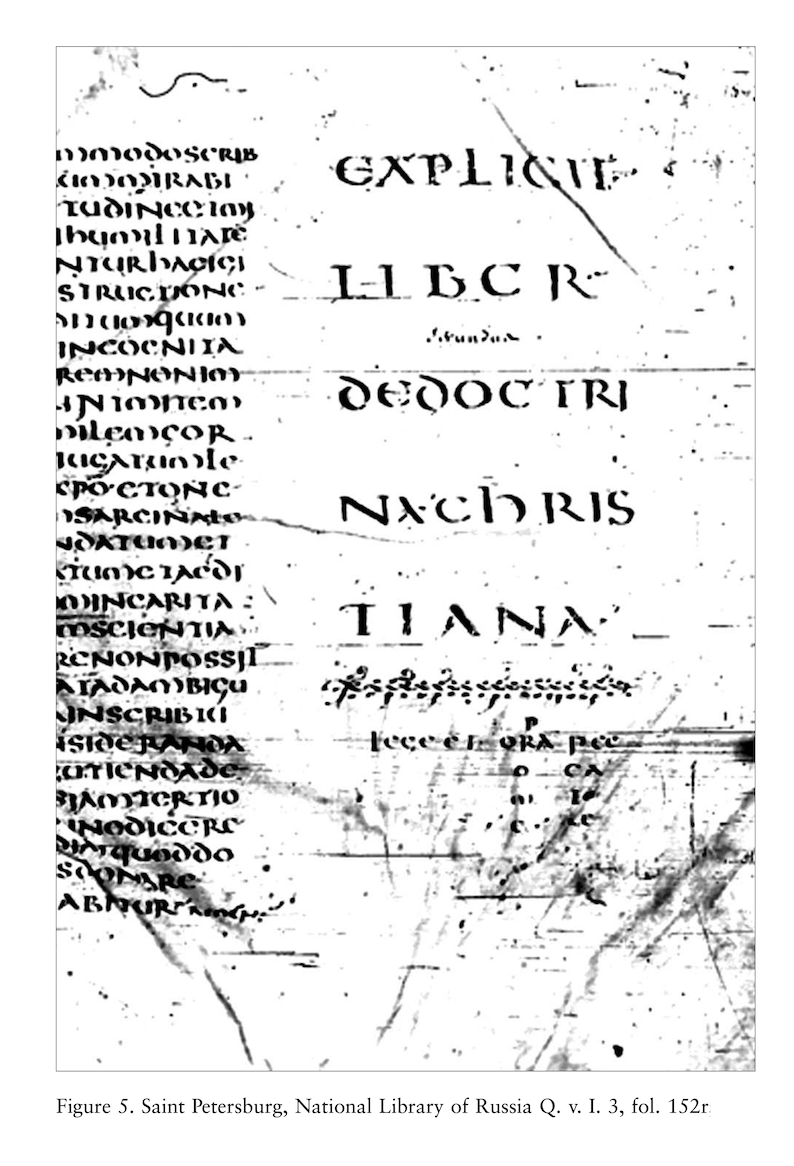
Writing it out, it reads: Lege et ora pro me peccatore, Agustinus. “Read and pray for me, a sinner, Augustine.”
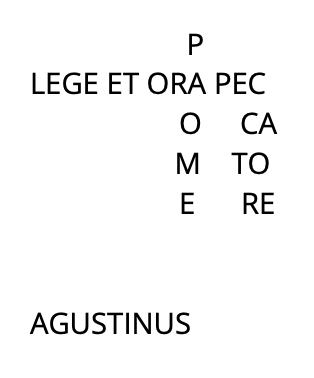
Why is “Agustinus” (note the spelling) almost entirely illegible? It’s because generations of readers venerated Augustine’s signature.
It is helpful for our students, and all of us, to remember that these great authors whose works we read were real people, who were tired, hungry, anxious, happy and sad just like us. And 1600 years of Christians have venerated this signature of St. Augustine. To have the actual handwriting of St. Augustine is a great gift. I am happy to share that with you and our students today.
Thank you for your continued support of St. Augustine. Fr. Byron Hagan of the Oratory offered Mass on February 6 on campus for our benefactors. It was good to come together and pray for the friends of our school.
